
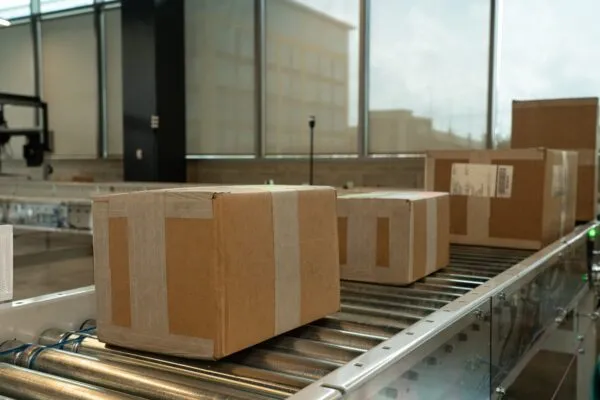
Package Handling
DCS’s design and engineering team has more than 40 years of experience creating unique parcel handling systems for diverse customer applications. With installations including semi-automated handling in small city distribution centers and fully automated, integrated hubs with advanced conveyor and sorter equipment, DCS routinely thinks outside the box.
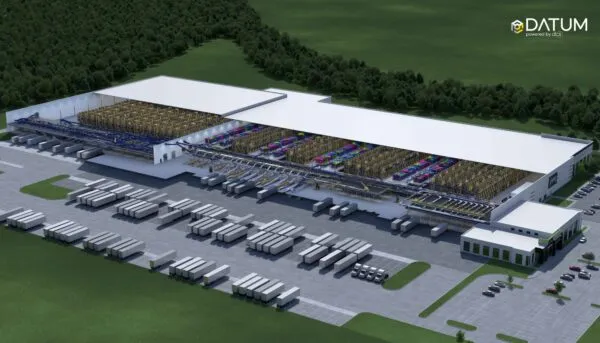
E-Commerce and Multi-Channel Fulfillment
DCS designs and implements end-to-end warehouse automation solutions for e-commerce and multi-channel retailers that address numerous workflow challenges. This includes solutions for receiving, putaway, storage, replenishment, order fulfillment, picking, packing, sortation, and outbound shipping. Our custom integrated warehouse, distribution, and fulfillment systems draw from a deep pool of conventional, semi-automated, and automated material handling technologies.
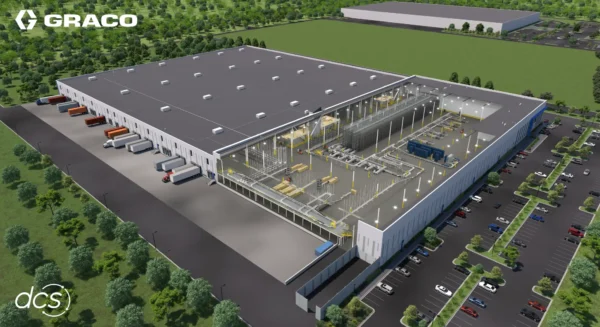
Various Distribution Applications
Whether an operation is considering the construction of a new distribution or fulfillment center, or a retrofit or expansion of an existing facility, it’s important to create a solution that fits the overarching supply chain strategy. DCS has four decades of experience designing and integrating comprehensive, end-to-end material handling solutions that meet a multitude of operational goals. Whether conventional, semi-automated, or fully automated, DCS can help your organization implement a custom solution that meets its goals while maximizing return on investment (ROI).

Supply Chain Consulting
The DCS Supply Chain Consulting team offers a range of services to help your operations address the challenges it faces. Working in partnership with you, DCS consultants analyze your business data- existing workforce, workflow processes, inventory, order data, operations, and more- to determine a strategy that addresses your unique needs. Whether you need an operations assessment, process improvement recommendations, or distribution design services, DCS consultants will help guide you to the material handling system or operational solution that best meets your current and future needs, as well as your budget.

Customer Support
Keeping your warehouse operations and material handling systems running smoothly and at the peak of productivity are the goals of DCS’ Customer Service Team. By partnering with DCS, your warehouse automation solution is supported from commissioning to end of life. You’ll receive comprehensive in-house training of your personnel, including specialized training of your designated internal system expert. Plus, DCS offers a complete package of spare parts and expert system troubleshooting support from qualified engineers dedicated to your installation.

System Design & Integration
DCS offers a broad range of material handling equipment and automated system design, installation, and integration services for a multitude of projects. These include retrofits, expansions, upgrades, and more. While every project is unique, our system design and execution processes are the same, encompassing meticulous attention to detail, frequent communication, and a dedicated partnership with our clients.
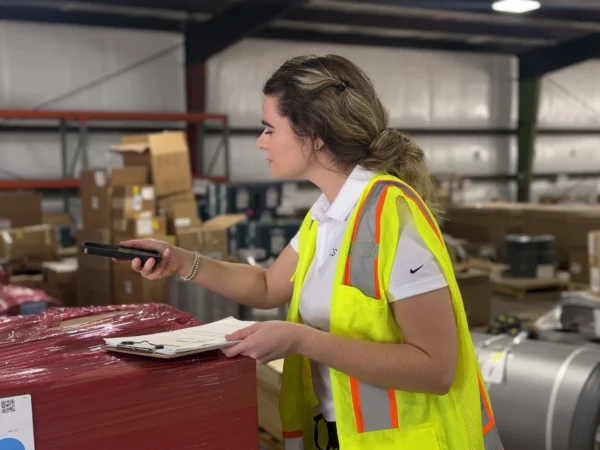
Lifecycle Services
Stop reactive repairs. Lifecycle Services provides expert preventive maintenance and 24/7 technical support to protect your automation and MHE availability.

Life Science & Healthcare
Pharmaceutical, healthcare, and life science companies face mounting pressure from evolving regulatory requirements, rising fulfillment costs, and intensifying accuracy demands. In this environment, automation isn’t optional—it’s essential. Designed Conveyor Systems (DCS) helps distributors of these critical products stay compliant and competitive.

Pet Food
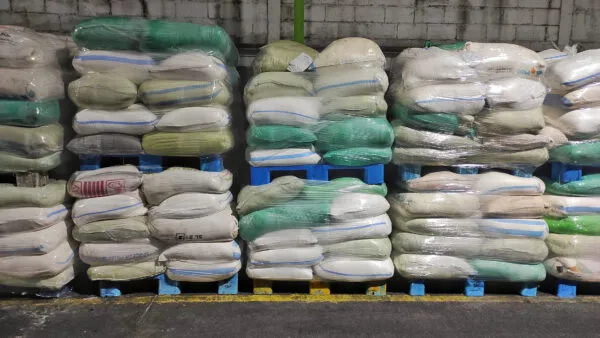
Pet food distribution operations are anything but standard. From bulky kibble bags to delicate fish tanks, stock keeping unit (SKU) complexity and fulfillment pressure are always on the rise. Designed Conveyor Systems (DCS) partners with leading pet retailers to design and engineer automation, software, and material handling systems that keep operations agile, accurate, and ready for what’s next.

Home Improvement
When your distribution center handles everything from hammers to hot tubs, operational complexity isn’t a challenge—it’s your daily reality. Home improvement retailers face intense pressure to meet rising consumer expectations across multiple channels—from in-store pickups to last-mile delivery. At Designed Conveyor Systems (DCS), we specialize in engineering material handling and automation solutions that help home improvement distribution centers keep pace, reduce cost, and drive accuracy at scale.

Sporting Goods
Navigating the unique demands of the sporting goods retail industry requires a distribution strategy that’s both agile and precise. From handling seasonal surges to managing a diverse range of products—from bulky equipment to small accessories—your warehouse operations are the key to a seamless customer experience. Our expertise helps sporting goods retailers streamline their distribution warehouses, improving order accuracy, boosting productivity, and ensuring your team can efficiently move products from the receiving dock to the final customer, no matter the season.

Footwear
In the fast-paced world of footwear retail requires a distribution strategy that can handle a vast array of styles, sizes, and seasonal trends with precision and speed. From managing a high volume of SKUs to ensuring accurate order fulfillment and returns processing, your distribution center is the engine that drives customer satisfaction and brand loyalty. Our expertise helps footwear retailers streamline their distribution centers, improving inventory management, accelerating order processing, and ensuring your team can efficiently move products from the receiving dock to the final customer, no matter the season.

Wholesale & Industrial Distribution
Designed Conveyor Systems (DCS) partners with wholesale, industrial, and electronics distributors to design efficient, optimized fulfillment solutions. Every operation DCS designs streamlines end-to-end functional processes—from inbound receiving and putaway to picking, packing, and shipping. Designed Conveyor Systems (DCS) partners with wholesale, industrial, and electronics distributors to design efficient, optimized fulfillment solutions. Every operation DCS designs streamlines end-to-end functional processes—from inbound receiving and putaway to picking, packing, and shipping.


About Us
Designed Conveyor Systems (DCS) has 40 years of experience serving major clients in multiple industries by providing material handling, full-scale warehouse operations, and conveyor design solutions that are custom crafted for their needs. DCS does not sell ready-made conveyor systems but builds relationships that empower collaboration to craft custom warehouse designs together. DCS utilizes consulting, engineering design, project management, installation services, and client support to ensure our customers can keep their promises to deliver on time.
Projects
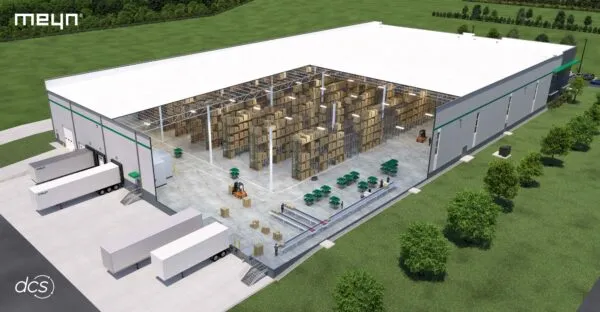
With more than 40 years of experience providing automated system design, installation, and integration services, DCS has created solutions for companies throughout the United States in a broad range of industries and markets. We’ve completed more than 1500 projects ranging from greenfield facilities with completely new systems to expansions and retrofits of existing operations.
Upcoming Events
Designed Conveyor Systems values building strong relationships with our clients. Join us at our upcoming events to collaborate and discover how we can design a custom warehouse solution tailored to your unique needs.
Flow Intelligence: How a WES with Multi-Agent Orchestration Capabilities Unlocks Predictive Throughput
Flow Intelligence: How a WES with Multi-Agent Orchestration Capabilities Unlocks Predictive Throughput

By Justin Ray, Principal, Software, DCS
High-volume fulfillment operations are no longer constrained by individual pieces of automation. Shuttles move faster, robots scale more easily, and storage systems are denser than ever. Yet many facilities still struggle to achieve consistent throughput—not because of equipment limitations, but because of flow.
As order profiles shift, peaks intensify, and operations grow more complex, static execution rules and siloed control systems fall short. Releasing work too early creates congestion. Releasing it too late starves downstream processes. Even when labor, robots, and automation are each performing well independently, overall system performance suffers without coordinated orchestration.
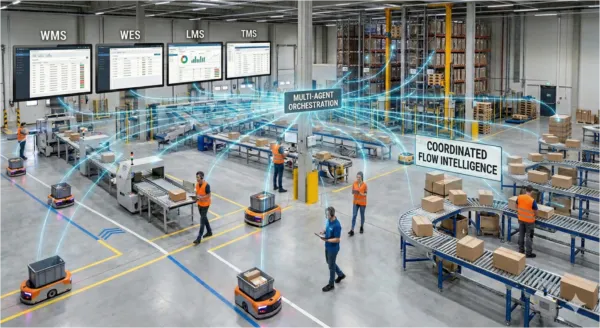
This is where flow intelligence changes the equation. By continuously monitoring performance, predicting bottlenecks, and dynamically optimizing how work moves through every zone, a warehouse execution system (WES) that integrates multi-agent orchestration (MAO) transforms automation from a collection of fast components into a unified, intelligent operation.
What Is Multi-Agent Orchestration?
Gartner defines multi-agent orchestration platforms as:
“…intelligent middleware that integrates and orchestrates work between various business applications, heterogeneous fleets of operational robots, and other automated agents…assigning work in near real time to adapt to changing conditions and demands.”
In practical terms, multi-agent orchestration within a WES coordinates a unified mix of people, conveyors, robots, and automation—treating every resource as part of the same execution model.
Within a WES, MAO is the mechanism that connects the data contained in a warehouse management system (WMS) to the automated systems the WES consolidates—enabling flow intelligence. Specialized agents represent flow zones, resources, buffers, and operational objectives. Each agent monitors its own performance while collaborating with others to optimize outcomes across the entire fulfillment operation.
Rather than relying on static logic or fixed priorities, MAO dynamically coordinates decisions such as:
- When and where work should be released.
- How priorities should shift as conditions change.
- Which resources should be assigned (or reassigned) to maintain balanced workflows.
The result is a continuously adapting execution environment that responds in real-time to variability, disruptions, and demand shifts. Instead of reacting to constraints after throughput degrades, it anticipates them—unlocking a game-changing operational advantage: predictive throughput.
From Local Decisions to System-Wide Flow Intelligence
Traditional warehouse control approaches optimize locally. A conveyor releases cartons when it can. A picking zone works its own queue. Labor reacts to avoid visible congestion in an aisle. While each decision may be logical in isolation, no single layer is responsible for coordinating flow end-to-end.
Conversely, a WES that integrates MAO enables flow intelligence by shifting optimization from isolated execution to coordinated orchestration. Instead of asking, “Is this resource busy?” the system evaluates whether work is moving through the operation at the rate required to meet throughput, service, and peak-volume goals.
By continuously evaluating how work should be prioritized, released, sequenced, and balanced across all flow zones—both human and automated—the WES focuses on sustaining smooth, predictable movement through the entire operation, not just keeping individual assets occupied.
Dynamic Optimization: Keeping Flow Aligned in Real-Time
At the core of flow intelligence is dynamic optimization—the ability to adapt continuously as conditions change inside the operation. Traditional, wave-based execution releases large volumes of work at fixed intervals, creating artificial peaks and valleys as upstream processes flood the system and downstream areas scramble to catch up.
Conversely, a WES with MAO replaces that stop-and-start rhythm with a continuous flow model, using real-time data to meter work release, reshuffle priorities, and adjust resource assignments as conditions evolve. Instead of reacting to congestion after it forms, the system continuously balances demand against capacity, keeping work moving at a steady, predictable rate across the entire operation.
This allows the system to balance demand against capacity across all workflows. If one area begins to slow, the system doesn’t wait for congestion to appear on a dashboard. It proactively redirects work, reassigns tasks across human and automated resources, and recalibrates execution plans to protect overall throughput.
The result? An operation that stays aligned to throughput goals throughout the day. Even as order profiles, labor availability, or system performance fluctuate, the WES uses MAO to prevent bottlenecks instead of reacting to them.
Continuous Monitoring and Predictive Insight Embedded in Warehouse Automation System
Flow intelligence begins with visibility into both current performance and future risks. A WES with MAO continuously monitors modeled versus actual performance across all active flow zones, tracking throughput rates, queue depths, and execution timing in real-time.
As work progresses, the system predicts completion times, required processing rates, and resource needs to meet defined service-level and peak-day goals. These predictions are continuously recalculated as conditions change, ensuring decisions remain grounded in reality—not assumptions.
This predictive insight shifts operations from reactive firefighting to proactive control. Bottlenecks are identified early, while corrective actions can still protect throughput.
Coordinating a Unified Mix of People and Warehouse Automation
Modern fulfillment operations rely on a blended mix of people, conveyors, robots, and automated equipment. Flow intelligence brings these resources together under a single execution model, coordinating how work moves across the operation rather than managing each element in isolation. A WES with MAO continuously measures real-time availability and capacity across this unified resource environment.
Using that system-wide view, work is assigned and sequenced based on current conditions and projected needs. Tasks are routed to the right combination of human and automated resources at the right time, minimizing idle labor, reducing congestion, and preventing upstream overload or downstream starvation before they impact throughput.
By treating people and automation as a coordinated resource network—rather than separate systems—flow intelligence breaks down the silos that traditionally limit performance. Humans, robots, and material handling systems operate as one system, aligned around shared throughput and service-level objectives, even as conditions change throughout the day.
Visibility That Proves What’s Working
Flow intelligence isn’t just about real-time decisions. It’s also about understanding performance over time. A warehouse execution system with MAO combines historical and real-time reporting to compare baseline operations against optimized outcomes, making improvement visible and measurable.
By tracking throughput, flow stability, and zone-level performance across shifts and peak periods, operations teams can clearly see how orchestration decisions impact results. Optimization becomes repeatable, defensible, and grounded in data.
This visibility is further strengthened through integration with vision systems, enabling more accurate resource detection and enhanced safety management. Together, real-time insight and historical context support continuous improvement driven by evidence—not intuition.
Turn Flow Intelligence into Your Operation’s Execution Advantage
As fulfillment operations become more automated and more complex, the ability to move work intelligently through the facility becomes a competitive differentiator. Flow intelligence—built on continuous monitoring, predictive modeling, and dynamic optimization—allows operations to anticipate constraints, balance resources, and sustain peak throughput without relying on manual intervention or static rules.
Multi-agent orchestration integrated into a warehouse execution system is what makes this possible at scale. That capability is built directly into DATUM™, DCS’s proprietary WES. By coordinating people, robots, and automation as a single system, DATUM™ delivers flow intelligence—transforming isolated assets into a cohesive, adaptive operation built for variability and growth.
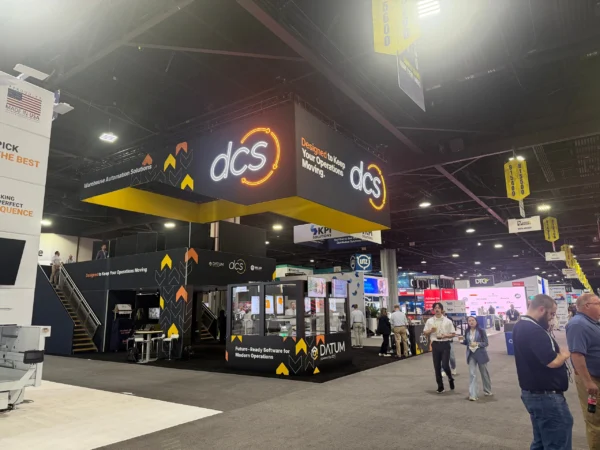
DATUM™ will be on display at MODEX 2026, Booth B15511, April 13–16 at the Georgia World Congress Center. Attendees will get a firsthand look at how execution software can synchronize and orchestrate an entire fulfillment operation to drive predictive throughput, end-to-end. Connect with DCS to learn how DATUM™ is redefining what a WES can—and should—do.